
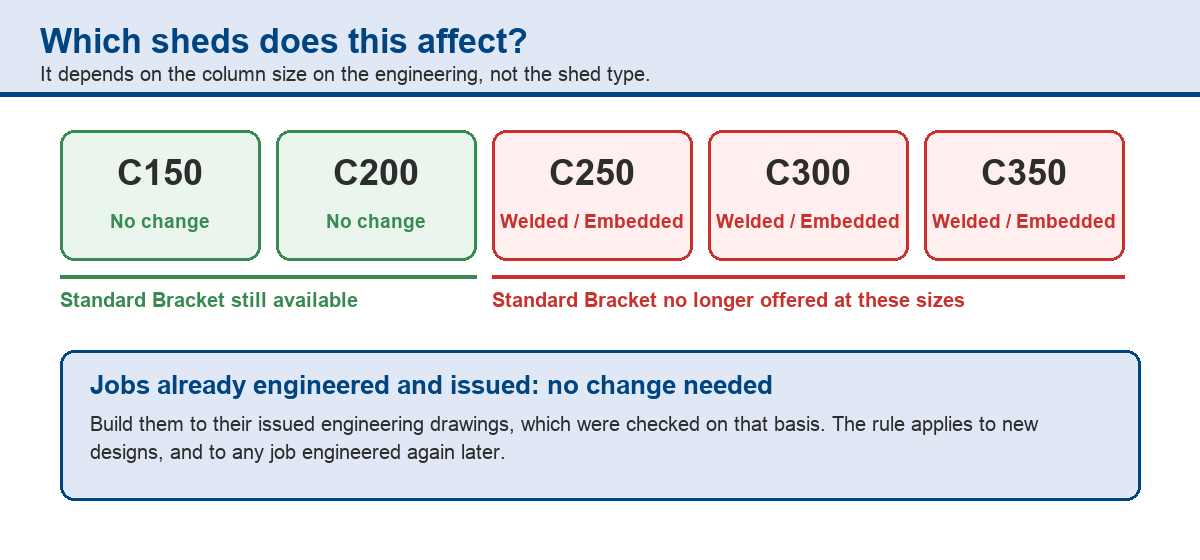
C250, C300 and C350 columns no longer use the Standard Bracket bolted down to the slab. They take a Welded Bracket or an Embedded Plate, both cast into the footing. C150 and C200 columns are unchanged and can keep the Standard Bracket. The reason is engineering: a bolted-down base is a pinned connection, and on larger frames the base needs to be fixed to carry the load.
What this means for your quotes
- On C250 and larger columns, quote a Welded Bracket or an Embedded Plate
- If a C250 or larger shed was priced with the Standard Bracket and hasn't been engineered yet, check the price before your customer accepts it
- Need bolt-to-slab on a particular job? Ask when you request the engineering
- Jobs already engineered and issued don't change
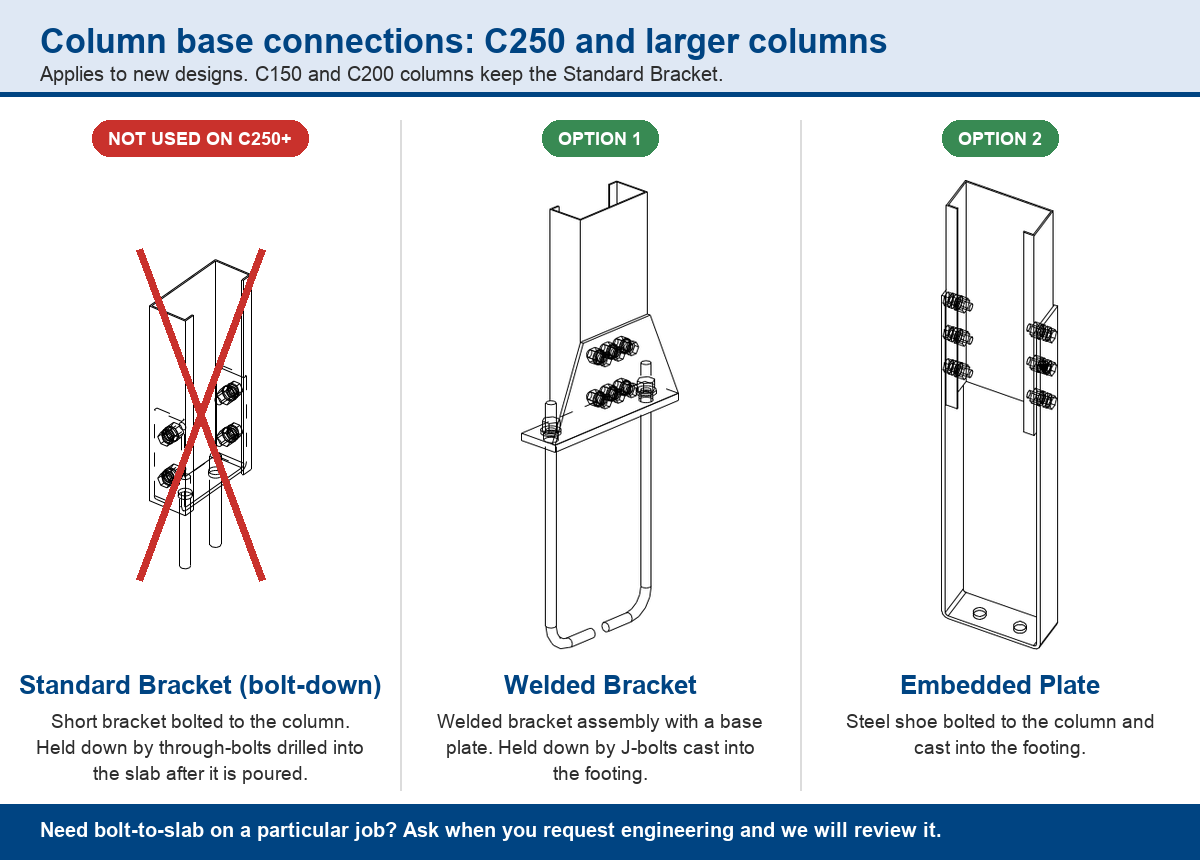
The three base connections
| Connection | How it's held down | Base type |
|---|---|---|
| Standard Bracket (bolt-down) | A short bracket bolted to the column, held down by through-bolts drilled into the slab after it's poured | Pinned |
| Welded Bracket | A welded bracket assembly with a base plate, held down by J-bolts cast into the footing | Fixed |
| Embedded Plate | A steel shoe bolted to the column and cast into the footing | Fixed |
Pinned and fixed bases
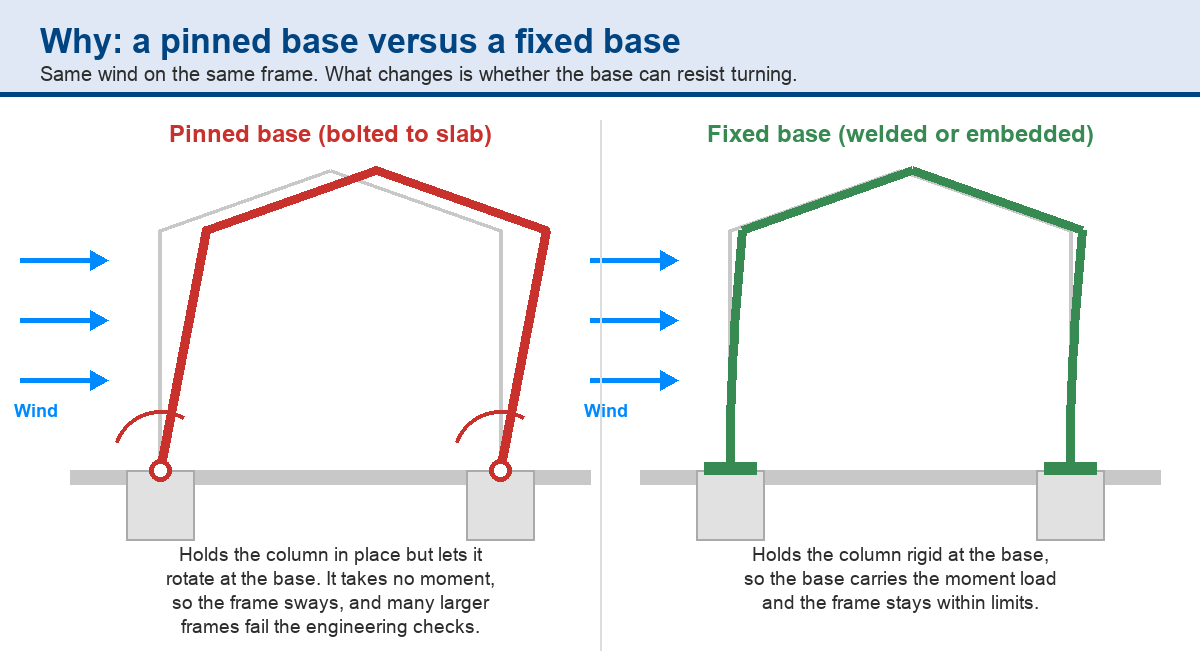
Every column base does two jobs: it holds the column in place, and it either lets the column turn at the base or stops it turning.
- A pinned base holds the column in place but lets it rotate at the base, like a hinge. It can't carry bending (moment) load. A bracket bolted down to the slab works this way, because a few bolts drilled into the slab can't stop the column turning.
- A fixed base holds the column rigid at the base. It stops the column turning, so the base carries the moment load. A bracket on cast-in J-bolts, or a shoe cast into the footing, works this way.
Pinned bases make the portal frame less rigid. That reduces how well the frame can transfer loads without failing in any one of the many failure modes checked under AS/NZS 4600 (cold-formed steel structures) and AS/NZS 1170 (structural design actions, including wind). Fixed bases keep the frame rigid at the base, so it can carry those loads through to the footings.
Why the size matters
On smaller frames, the engineering works with a pinned base: the frame can carry the load without help from the base. That's why the Standard Bracket stays available, as the lower-cost choice, for C150 and C200 columns.
Larger frames are taller, wider, or both, so the wind loads and the moments they create are higher. On C250 and larger columns the base needs to be fixed to carry those moments. With a pinned base, many of these frames fail the engineering and design checks. So ShedMate engineering no longer uses the bolt-down Standard Bracket on C250, C300 and C350 columns.
A fixed base isn't the default everywhere because it costs more. The welded base plate is heavier and more expensive, so it's used where the engineering needs it.
What you'll see in ShedMate
On C250 and larger columns, ShedMate no longer lets you select the Standard Bracket as the column base. Choose a Welded Bracket or an Embedded Plate instead. Projects that already had the Standard Bracket selected keep it, so an older quote can still show it.
Building on an existing slab
Sometimes bolt-to-slab is the only practical option, for example when the shed is going onto a slab that's already poured. If a C250 or larger job needs it, tell us when you request the engineering and we'll review that job on its own. Many C250 and larger frames won't pass with a pinned base, so in most cases the answer will still be a Welded Bracket or an Embedded Plate. Ask before you promise bolt-to-slab to your customer.
Jobs already engineered and issued
Nothing changes on jobs that have already been engineered and issued. Build them to their issued engineering drawings, which were checked on that basis. The rule applies to new designs, and to any job engineered again later.
Check open quotes on larger sheds. If you have quotes out on C250 or larger sheds that still show the Standard Bracket and haven't been engineered yet, the base connection will change when they are. The Welded Bracket and Embedded Plate cost differently, so check those quotes before your customer accepts them.