
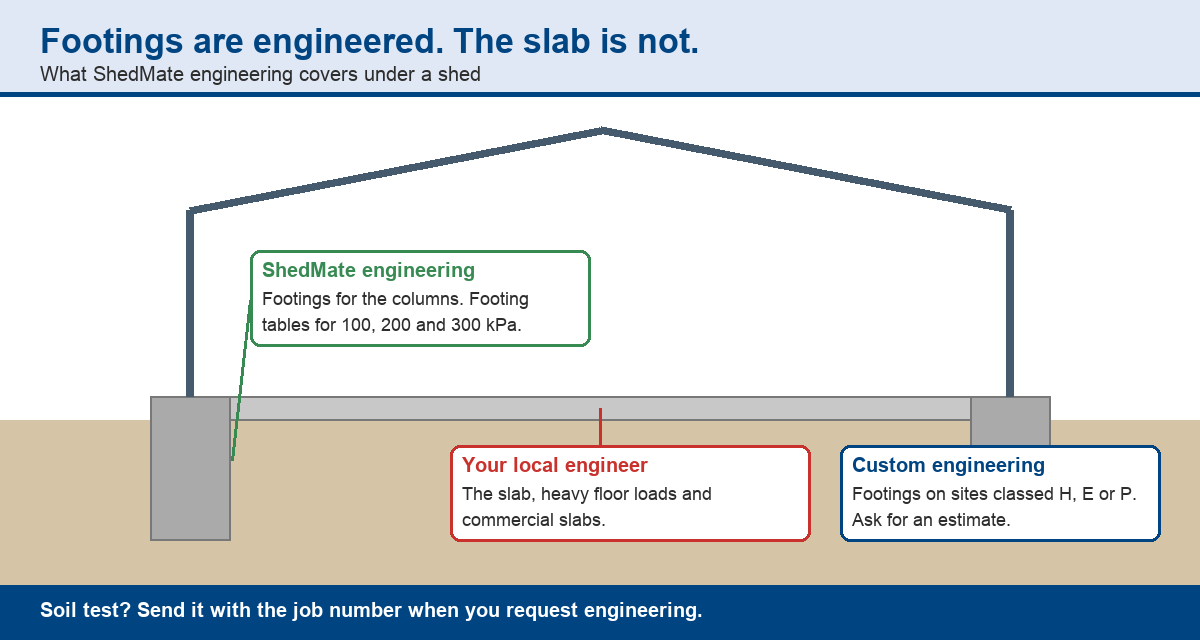
ShedMate engineering covers the shed's footings, not the slab. The engineering report includes footing tables for three ground bearing capacities: 100, 200 and 300 kPa. A soil test tells your builder which one applies. We don't design slabs at the moment, so for a slab your customer needs a local engineer. Highly reactive or problem sites need their footings designed as custom engineering.
Before you quote footings or a slab
- Quote the footings from the shed's engineering, not the slab
- Tell your customer the slab is designed by a local engineer
- Got a soil test? Send it with the job number when you request engineering
- Site classed H, E or P? Ask us for custom engineering before you quote
What the engineering covers
| Covered by ShedMate engineering? | Who handles it | |
|---|---|---|
| Footings for the shed's columns | Yes. The report has footing tables for 100, 200 and 300 kPa ground bearing capacity | ShedMate engineering |
| Matching footings to a soil test | Yes, when the soil test is sent with the engineering request | ShedMate engineering |
| Footings on a highly reactive or problem site (for example class H, E or P) | Yes, as custom engineering. Ask for an estimate first; it isn't a fast turnaround | ShedMate engineering, custom |
| The slab | No, not at the moment | A local engineer |
| Heavy floor loads or commercial slabs | No. These need specialist design | A local engineer |
Why we don't design slabs
A slab design has to be backed by on-site inspection certificates from the engineer who signs it. That isn't practical for us to support from a distance, so we don't design slabs at the moment. A local engineer can do the inspections and work with your certifier or council. Heavy loads, reactive soil and commercial uses add their own checks, which a local engineer is better placed to make.
What to do with a soil test
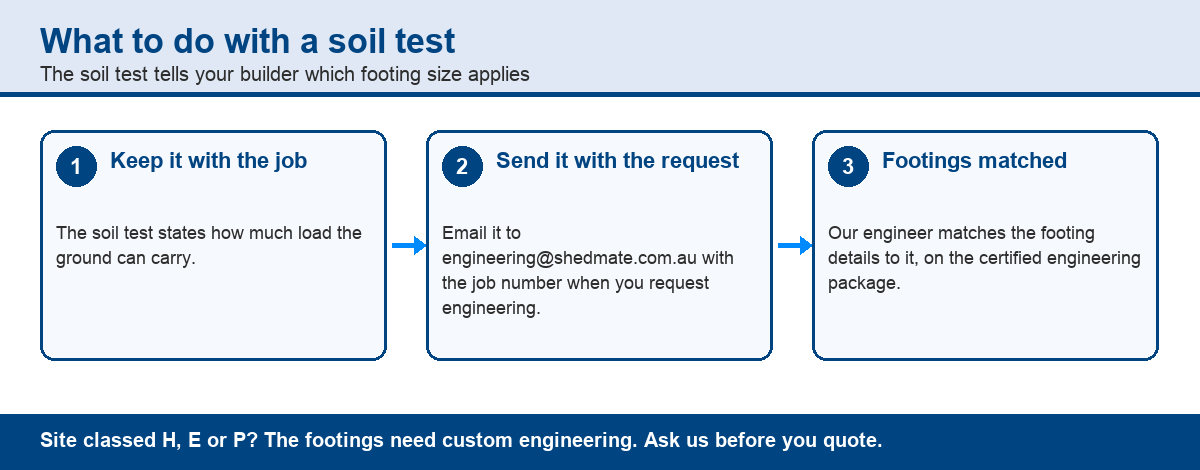
A soil test is worth having. It states how much load the ground can carry (its bearing capacity), and that tells your builder which footing size in the tables applies.
- Keep the soil test with the job.
- When you request the engineering, email it to engineering@shedmate.com.au with the job number.
- Our engineer matches the footing details to it, and they come with the certified engineering package.
Check the site class before you quote. If the soil test classes the site as highly reactive or a problem site (for example class H, E or P), the standard footing tables don't apply. The footings need designing for that site as custom engineering. Ask us for an estimate before you quote, and allow more time than a standard request.
Building on a slab that's already poured
If the shed is going onto an existing slab, tell us when you request the engineering. Bolting columns down to a slab gives a pinned base, and some sheds need a fixed base cast into the footing instead. Carports and sheds with C250 or larger columns need their bases cast in. So ask before you promise your customer bolt-to-slab. See Why can't I use a bolt-down base bracket on larger columns?
Related articles
Stuck? Email support@shedmate.com.au with the job number.