
An item's category identifies the type of item in your pricing database, such as Structural Frames, Doors or Logistics. It helps your pricing calculations find the relevant parts of the shed and their details.
Choose a category for what the item is. For example, use Structural Frames for a C-section and Logistics for delivery. A category is different from a group or a view used to organise the pricing screen.
Where to find an item's category
- Open a job and go to Instant Quoting → Pricing Database.
- Find the item. Its category appears in the Category column.
- If the field is editable, click it to open the category list. Use the search box to find a category.
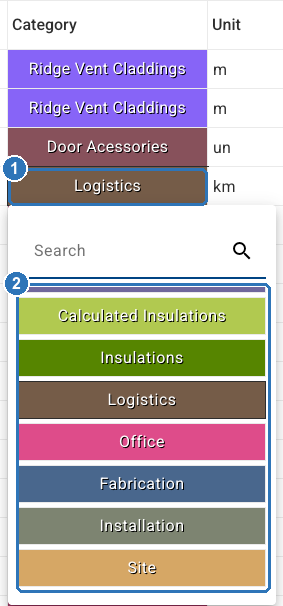
If the category is unavailable or greyed out, ask your company's database administrator or ShedMate support for help. The controls available to you depend on your access and setup.
Changing a category can affect your quote. Before changing an existing item, check its linked calculation and test the result. Do not change a shared database just to investigate an unexpected quantity.
Choose the category that matches the item
Use the category for the actual component or service. A roller door belongs in Doors; a door motor sold separately may belong in Door Acessories. A delivery charge belongs in Logistics.
Set the category when an item is first added or imported. Selecting a category does not create a pricing calculation or guarantee that the item will be quantified.
Categories in the pricing database
The following names match the category list in ShedMate, including Equipments, Door Acessories and Window Acessories. Use those labels when searching the list.
| Category | Items it is used for |
|---|---|
| Structural Frames | C sections, SHS, RHS, Z and top hat sections, bracing straps |
| Sliding Panel Tracks | Tracks for sliding panels |
| Connections | Brackets, column stiffeners |
| Fixings | Screws, bolts, through bolts, dynabolts, turnbuckles |
| Claddings | Trimdek, Corrugated, low-profile and panel sheeting |
| Flashings | Barge trims, ridge caps, wall corners, rakers, door header flashings |
| Ridge Vents | Ridge vents |
| Ridge Vent Claddings | Cladding for ridge vents |
| Gutters | Square fascia, half round, quad and internal gutters |
| Pipes | Downpipes in PVC or steel |
| Pipe Accessories | Downpipe brackets, stop ends, pops |
| Floors | Concrete aprons, mezzanine flooring, reinforcing mesh |
| Footings | Structural footings |
| Panels | Panels |
| Walls | Costs for walls other than cladding |
| Roofs | Skylight protection mesh |
| Windows | Windows |
| Doors | Roller doors, sectional doors, PA doors |
| Bay Openings | Costs for bay openings |
| Equipments | Spinaways |
| Door Acessories | Roller door motors and chains, sliding panel brackets, tracks, rollers, stops, pad lock bolts |
| Window Acessories | Window accessories |
| Vermin Proofings | Vermin seals for Trimdek and Corrugated |
| Calculated Insulations | Calculated insulation items |
| Insulations | Blanket and rolls |
| Logistics | Freight, delivery |
| Office | Plans, planning lodgement, certificates of title |
| Fabrication | Welding, fabrication |
| Installation | Installation and labour |
| Site | Equipment hire, safety equipment, site machinery |
How categories affect pricing calculations
A calculation normally uses the category of its linked price item. Where a calculation has its own category override, that override determines the model items it reads. The calculation's rules can then narrow down which items to include.
Different types of model item provide different details. For example, a frame may have length, mass and profile details; a window may have width, height, make and colour. The properties available in a calculation depend on the category it reads and the relevant model items. Check the property choices in that calculation rather than assuming every category has the same fields.
A service category can still be priced using other inputs. Delivery in Logistics, for example, can use a public delivery-distance variable. A category with no component-specific model properties does not mean that variables or formulas cannot be used to calculate its price.
If an item is not quantified
Before changing the category:
- Check that the price item is linked to the intended calculation.
- Check the price item's category and any category override in the calculation.
- Check that the calculation's rules match the parts of the shed you want to price.
- If it uses a public variable, check that the required input has a value.
- Review the resulting quantity and quote totals in a test job before applying database changes more widely.
For example, an accessory calculation that needs information about a door may need to read Doors, even though the price item is under Door Acessories. Check the existing setup before moving the price item.
Watch the original overview
The original Instant Quoting overview video is retained above. Jump to 6:02 for item categories. The recording also covers the wider pricing database and calculations; some screen details may differ from your current version.
- 0:00 — Introduction
- 0:35 — Competitive advantage
- 1:03 — Workflow review
- 1:42 — Access the pricing database
- 2:10 — Database applications
- 3:05 — Price rises
- 3:37 — System flexibility
- 4:00 — Explore the pricing database
- 5:04 — Import and export
- 6:02 — Item categories
- 9:26 — Pricing calculations
- 10:14 — Groups
- 12:29 — Pricing process summary
- 14:03 — Next steps
Related help
- Set up your prices so you can quote
- Why does an item show as not quantified, and what do I do?
Need help choosing a category or checking a quantity? Email support@shedmate.com.au with your company name, the item name and what you expected to calculate.